



Ethernet: The Invisible Backbone of the Metaverse

It has never been more important, as the metaverse finally makes its way from being a concept of the future to an integral part of our digital lives. The metaverse, with its basis in virtual reality, augmented reality, and immersive 3D, requires a highly digital infrastructure. While much of the spotlight is on blockchain, AI, and wireless technologies, Ethernet stands out as the quiet yet powerful foundation that enables smooth, immersive experiences within the metaverse.
Metaverse: A Step Towards Digital Reality
The metaverse isn't just any virtual space; it's a digital universe to which people relate every day, as much as they do with physical space. Be it for employment or playing games, the metaverse is being vastly integrated into our digital economy at large and not merely keeping itself within the circles of entertainment.
But for such a grand vision to be realized, the metaverse depends on ultra-low latency, high-speed data transfer, and always-on connectivity—all of which make Ethernet indispensable.
Why is Ethernet Important to the Metaverse?
1. Ultra-Low Latency
Every interaction in the metaverse—from attending a virtual event to playing a multiplayer game—is done in real time. Even small latency, especially in data transfer, makes these experiences fail.
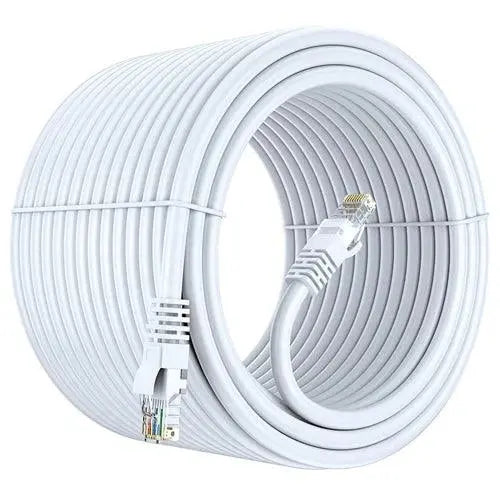
Low latency as low as 1-2 milliseconds is achieved with high-performance Ethernet cables such as CAT 8, making them perfect for the demanding applications of the metaverse.
2. High-Quality Streaming and Bandwidth
The richness of every aspect of virtual life in the metaverse-based, visually rich high-definition requires higher bandwidth. Modern Ethernet cables, in this scenario, easily and uninterruptedly handle massive data requirements ranging up to 40 Gbps in speed.
While Wi-Fi congestion and performance issues are common, Ethernet presents a wide, stable, and reliable connection that makes metaverse exploration possible without lag and buffering.
3. Wireless Stability
Despite advances with 5G and Wi-Fi 6, for example, wireless technologies still are plagued by interference and spotty connections.
With Ethernet, the stability and interference-free connectivity are unparalleled, which is extremely important in applications like virtual reality gaming, wherein the data feed has to be constant. Without a stable connection, the immersive experience of the metaverse falters.
4. The Backbone of Data Centers
The metaverse is powered not just by user devices, but complex graphics rendering, AI processing of interactions, and colossal data storage are done by very large data centers that lie at the core of its functionality.
It interconnects these data centers-located servers via Ethernet to handle data efficiently for faster processing in order to meet the colossal data requirement of the metaverse.
5. Enable Edge Computing
The metaverse is increasingly using edge computing, which places data processing closer to the user to reduce latency and increase speeds.
Ethernet is central in establishing strong connections between edge devices and central servers to ensure speedy data processing, thus guaranteeing a smooth user experience.
Ethernet for the Future: An Evolving Backbone
Ethernet technology is still evolving. Innovations, such as PoE, or Power over Ethernet, transmit both data and power using the same cable, extending its range. Researchers continue testing standards for faster speeds so Ethernet will be ready when metaverse needs to emerge.
Conclusion
The metaverse is a digital revolution—a digital revolution that demands ultra-fast, highly reliable connectivity. As important as wireless technologies will be, Ethernet provides the solid foundation on which this virtual universe will be built.
Next time the metaverse becomes a topic of discussion, be certain to look beyond state-of-the-art gadgets and software. In that light, consider Ethernet the unsung enabler of this revolutionary digital world.